
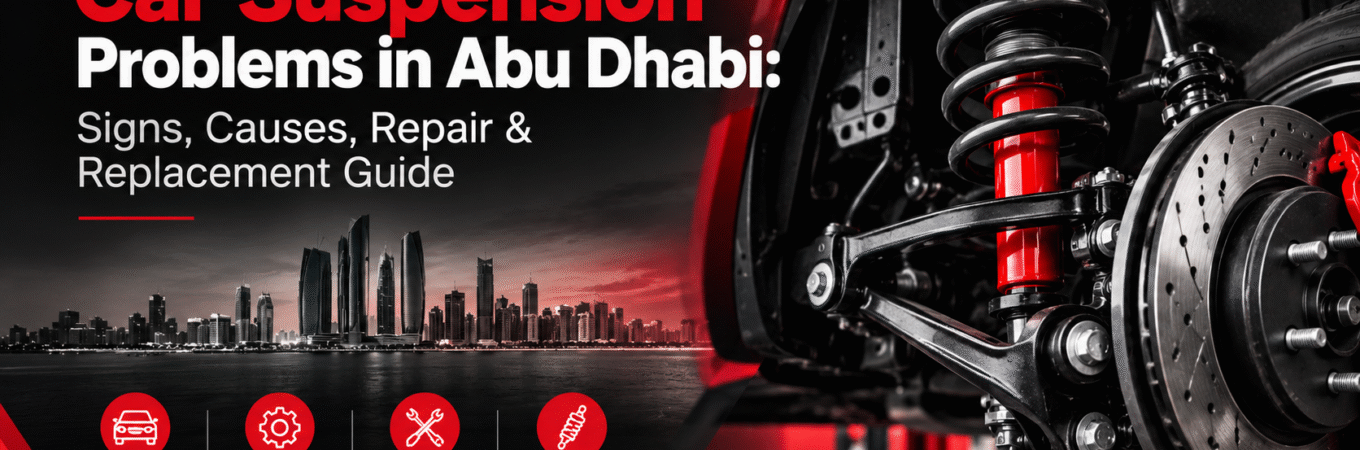
Your car’s suspension system does much more than make your drive comfortable.
It helps keep the tyres in contact with the road, supports vehicle stability, controls body movement, and works together with the steering and braking systems.
When the suspension starts to wear out, you may notice unusual noises, excessive bouncing, uneven tyre wear, steering problems, or a rougher ride.
For drivers in Abu Dhabi, regular suspension inspection is particularly important. Daily traffic, speed bumps, uneven road surfaces, high temperatures, and extensive highway driving can all place demands on suspension components.
If your car no longer feels as stable or comfortable as it used to, it may be time for a professional car suspension inspection in Abu Dhabi.
This guide explains the common signs of suspension problems, what causes them, which components may be affected, and when repair or replacement is necessary.
What Does a Car Suspension System Do?
The suspension system connects the vehicle body to its wheels and helps control how the vehicle responds to road surfaces.
Depending on the vehicle, the system can include:
- Shock absorbers
- Struts
- Coil springs
- Control arms
- Ball joints
- Bushings
- Stabilizer bars
- Stabilizer links
- Tie rods
- Wheel bearings
- Other mounting and suspension components
These parts work together to control movement and maintain contact between the tyres and road.
A suspension problem does not always mean that the shock absorbers are bad. Several components can produce similar symptoms.
That is why accurate diagnosis is important before replacing parts.
10 Signs of Suspension Problems
Suspension problems can develop gradually.
Knowing the warning signs can help you arrange an inspection before a small issue affects other components.
1. Your Car Bounces Excessively
A certain amount of movement is normal when driving over bumps.
However, if your vehicle continues bouncing after passing over a speed bump or uneven road, worn shock absorbers or other suspension components may be involved.
A simple bounce test can sometimes provide a clue, but it is not a substitute for professional inspection.
2. The Ride Feels Unusually Rough
If your vehicle suddenly feels much harsher over bumps, potholes, or uneven surfaces, a suspension component may be worn or damaged.
A rough ride can also be caused by tyre pressure, tyre condition, or other vehicle issues.
The source should be identified rather than assuming that the shock absorbers are responsible.
3. Knocking or Clunking Sounds
A knocking, clunking, or rattling noise from the suspension area can indicate worn or damaged components.
Potential causes include:
- Worn bushings
- Stabilizer links
- Ball joints
- Control arms
- Strut mounts
- Shock absorber components
The location and timing of the noise can help a technician identify the cause.
For example, a noise that occurs mainly when going over bumps may require a different diagnostic approach from a noise that occurs while turning.
4. Your Car Pulls to One Side
If the vehicle consistently moves to one side while driving, several systems could be involved.
Possible causes include:
- Wheel alignment
- Uneven tyre pressure
- Tyre problems
- Suspension wear
- Steering component issues
- Uneven braking
Because pulling can have multiple causes, it is important to inspect the complete system.
5. Uneven Tyre Wear
Your tyres should normally wear relatively evenly when the vehicle’s alignment, suspension, tyre pressure, and other related systems are functioning correctly.
If one tyre is wearing significantly faster than the others, the cause should be investigated.
Possible reasons include:
- Incorrect wheel alignment
- Worn suspension components
- Incorrect tyre pressure
- Wheel imbalance
- Damaged components
Simply replacing the tyre without addressing the underlying problem may result in the new tyre wearing unevenly as well.
6. Excessive Body Roll During Turns
If the car leans noticeably more than usual while cornering, the suspension system may not be controlling body movement effectively.
Worn shocks, springs, stabilizer components, or other suspension parts may contribute to excessive body movement.
Changes in handling should always be taken seriously.
7. The Front of the Car Dives Under Braking
When you brake, some forward weight transfer is normal.
However, excessive nose diving can indicate worn suspension components.
Because braking performance and suspension behaviour are closely connected, excessive movement under braking should be inspected alongside the brake system.
8. The Rear of the Car Squats During Acceleration
If the rear of the vehicle drops excessively when accelerating, worn shocks or springs may be involved.
Heavy loads can make the symptom more noticeable.
The vehicle’s suspension should be capable of controlling normal acceleration and load conditions without excessive movement.
9. Steering Feels Unstable
A worn suspension or steering component can affect how confidently the vehicle responds to steering inputs.
You may notice:
- Loose steering
- Delayed response
- Wandering
- Excessive movement
- Difficulty maintaining a straight line
These symptoms can also be caused by tyres or wheel alignment, so proper diagnosis is essential.
10. The Vehicle Sits Lower on One Side
If one corner of the vehicle appears noticeably lower than another, there may be a problem with a spring or another suspension component.
A damaged or weakened spring can affect ride height and handling.
This should be inspected rather than ignored.
What Causes Suspension Problems in Abu Dhabi?
Suspension wear is affected by the vehicle, road conditions, mileage, driving habits, and component quality.
Abu Dhabi’s driving environment can also influence suspension wear.
Speed Bumps and Road Surfaces
Frequent driving over speed bumps, uneven surfaces, potholes, and road imperfections places repeated loads on suspension components.
Approaching bumps at excessive speed can increase the force transferred through the suspension.
Heavy Traffic
Stop-and-go traffic affects more than the engine and brakes.
Frequent braking, acceleration, steering, and low-speed manoeuvring can contribute to wear across several vehicle systems.
High Temperatures
Abu Dhabi experiences high ambient temperatures for significant parts of the year.
Heat can contribute to the ageing of rubber components such as bushings and mounts.
However, suspension wear is usually the result of multiple factors rather than temperature alone.
Vehicle Load
Carrying heavy loads regularly places additional stress on suspension components.
Vehicles used for frequent long-distance travel, commercial purposes, or heavy loads may require closer attention to suspension condition.
Driving Habits
Hard acceleration, aggressive cornering, high-speed driving over bumps, and sudden impacts can increase suspension stress.
Smooth driving can help reduce unnecessary loads.
What Are Shock Absorbers?
Shock absorbers are one of the most important components of the suspension system.
Their main function is to control the movement of the springs and suspension.
Without effective damping, the vehicle may bounce excessively after hitting a bump.
Worn shock absorbers can affect:
- Ride comfort
- Vehicle stability
- Tyre contact with the road
- Cornering behaviour
- Braking stability
That is why shock absorber replacement in Abu Dhabi may be necessary when inspection confirms excessive wear or damage.
What Happens When Shock Absorbers Wear Out?
Worn shock absorbers can make the vehicle feel less controlled.
Common signs include:
- Excessive bouncing
- Increased body movement
- Nose diving during braking
- Rear-end squatting during acceleration
- Poor cornering stability
- Uneven tyre wear
- Oil leakage from the shock absorber
However, not every suspension symptom means the shock absorbers need replacement.
A technician should inspect the complete suspension system.
Common Suspension Components That Can Fail
Control Arms
Control arms connect the wheel assembly to the vehicle body and allow controlled wheel movement.
Worn control arm bushings or ball joints can cause noise, steering changes, and uneven tyre wear.
Bushings
Bushings reduce vibration and allow controlled movement between suspension components.
Over time, rubber bushings can deteriorate, crack, or become worn.
Ball Joints
Ball joints allow controlled movement between suspension and steering components.
Wear can affect steering and wheel movement.
Because ball joint failure can create serious safety risks, suspected wear should be addressed promptly.
Stabilizer Links
Stabilizer links connect the stabilizer bar to the suspension.
Worn links can produce knocking or rattling noises, particularly over uneven surfaces.
Coil Springs
Springs support vehicle weight and contribute to ride height.
A damaged or weakened spring can cause the vehicle to sit unevenly or affect handling.
Is Suspension Repair the Same as Wheel Alignment?
No.
They are related, but they are not the same service.
Suspension Repair
Suspension repair involves inspecting and repairing or replacing worn or damaged suspension components.
Wheel Alignment
Wheel alignment adjusts the angles of the wheels according to the vehicle manufacturer’s specifications.
A vehicle may need alignment after certain suspension repairs.
However, alignment alone will not fix a worn ball joint, damaged control arm, broken spring, or leaking shock absorber.
If your car pulls to one side, unevenly wears tyres, or handles differently, the underlying cause should be diagnosed first.
Can Bad Suspension Affect Your Tyres?
Yes.
Suspension and tyres work together to maintain proper contact with the road.
A worn or damaged suspension component can contribute to abnormal tyre wear.
This may appear as:
- Inner-edge wear
- Outer-edge wear
- Uneven patches
- Cupping or scalloping
- Accelerated tyre wear
However, incorrect tyre pressure and wheel alignment can produce similar patterns.
A proper inspection should consider all related systems.
Can Suspension Problems Affect Braking?
Yes.
Suspension condition can influence vehicle stability during braking.
For example, worn shocks may contribute to excessive weight transfer or reduced control over uneven surfaces.
This does not mean every braking problem is caused by suspension.
Brake components should always be inspected separately when braking performance changes.
For a deeper look at brake symptoms, an internal article such as “Car Brake Problems in Abu Dhabi: Warning Signs, Common Causes & When to Get Your Brakes Checked” can help readers understand when brake inspection is necessary.
When Should You Get Your Suspension Checked?
You should consider a professional suspension inspection if you notice:
- New knocking or clunking noises
- Excessive bouncing
- Uneven tyre wear
- Steering instability
- Excessive body roll
- A change in ride height
- The car pulling to one side
- Oil leakage from a shock absorber
- Unusual movement while braking
- A significant change in ride comfort
You should also consider an inspection after a significant pothole or road impact.
A visible lack of damage does not necessarily mean that the suspension is unaffected.
How Is a Car Suspension Problem Diagnosed?
A professional diagnosis usually begins with the symptoms you describe.
The technician may then inspect:
Visual Condition
Components are checked for visible damage, leakage, cracks, corrosion, or abnormal wear.
Suspension Movement
The vehicle’s suspension behaviour may be assessed under controlled conditions.
Bushings and Joints
Bushings, ball joints, stabilizer links, and other joints are checked for excessive movement or deterioration.
Shock Absorbers
Technicians may inspect for leakage and signs of reduced damping performance.
Tyres
Tyre wear patterns can provide useful clues.
Steering and Alignment
If the vehicle pulls or feels unstable, steering and alignment-related components may also be checked.
The objective is to identify the actual source of the problem before recommending replacement.
How Much Does Suspension Repair Cost in Abu Dhabi?
There is no fixed car suspension repair cost in Abu Dhabi.
The price depends on:
- Vehicle make and model
- Suspension design
- Component requiring replacement
- Parts quality
- Labour
- Number of components affected
- Whether alignment is required afterward
Replacing a single stabilizer link is very different from replacing multiple control arms and shock absorbers.
That is why a proper inspection and vehicle-specific quotation are more useful than a generic price estimate.
Should You Replace One Shock Absorber or Both?
This depends on the vehicle and the condition of the suspension.
In many applications, shock absorbers on the same axle are replaced as a pair to maintain more consistent damping.
However, the correct recommendation depends on the manufacturer’s requirements, component condition, vehicle design, and inspection results.
A qualified technician should advise you after checking the vehicle.
How to Protect Your Car’s Suspension
You cannot prevent normal suspension wear completely, but good driving and maintenance habits can help.
Slow Down for Speed Bumps
Reduce speed before the bump instead of braking aggressively while crossing it.
Avoid Potholes Where Safe
If a pothole cannot be avoided, reduce speed and maintain control of the vehicle.
Maintain Correct Tyre Pressure
Incorrect tyre pressure can affect ride quality and increase stress on tyres and suspension.
Do Not Overload the Vehicle
Stay within the manufacturer’s recommended load limits.
Check Uneven Tyre Wear
Unusual tyre wear can provide an early indication of alignment or suspension problems.
Inspect After Major Impacts
A significant pothole or road impact can damage suspension or steering components even if the damage is not immediately visible.
Suspension Inspection and Repair at Aarya Auto
Aarya Auto provides multi-brand vehicle maintenance and repair services for drivers in Abu Dhabi.
The workshop can assist with suspension inspections, diagnosis, shock absorber-related repairs, steering and suspension component replacement, and other vehicle maintenance requirements.
With more than 17 years of automotive experience, Aarya Auto focuses on identifying the cause of a vehicle problem before recommending the appropriate repair.
This is particularly important with suspension problems because symptoms such as vibration, pulling, uneven tyre wear, and noise can originate from several different systems.
A proper diagnosis helps avoid replacing parts unnecessarily.
For customers who want broader preventive vehicle maintenance, Aarya Auto also offers the Affordable Service Package.
The package includes:
- 4 Minor Services
- 1 Major Service
- 3 Years or 50,000 KM coverage
- Free replacement of fluids, filters and brake pads
- Free brake disc skimming
- Free pickup and drop
- 20% off extra labour
- 20% off ceramic coating, tinting and paint protection
- Free RTA Pre-Inspection and OBD2 reports
Package terms, eligibility, and vehicle applicability should be confirmed with Aarya Auto before booking.
Frequently Asked Questions
What are the signs of a bad suspension?
Common signs include excessive bouncing, knocking sounds, uneven tyre wear, excessive body roll, steering instability, pulling to one side, uneven ride height, and oil leakage from shock absorbers.
How often should car suspension be replaced?
There is no universal replacement interval. Suspension components wear according to mileage, road conditions, driving habits, vehicle load, and component quality. They should be inspected periodically and replaced when worn or damaged.
How much does suspension repair cost in Abu Dhabi?
Suspension repair costs depend on the vehicle and the components that require repair or replacement. A professional inspection is necessary to provide an accurate estimate.
How do I know if I need new shock absorbers?
Excessive bouncing, poor body control, nose diving, rear